Owner help
Your certificate of occupancy is waiting on radio coverage. Here is the fastest path.
New buildings must provide approved in-building radio coverage for emergency responders (IFC 2021 510.1), and many places hold the certificate of occupancy until the system or a passing test is approved. In Broward County, no certificate of occupancy or completion is issued until the ERCES is approved by every authority and the radio license holder (FBC Broward 118.1.4). The fastest path is an early signal test, a design built to the fire department's criteria (IFC 2021 510.4.2.2), the license holder's consent requested early, fire alarm monitoring coordinated (IFC 2021 510.4.2.5), and a passing grid test on every floor (IFC 2021 510.5.4).
Why the radio test is holding your CO
The model fire code requires approved in-building, two-way emergency responder radio coverage in all new buildings, judged against the public safety signal outside (IFC 2021 510.1). Florida law also requires new and existing buildings, unless exempt, to meet the minimum signal level the local fire marshal sets (F.S. 633.202(18)(a), (18)(b)).
Local rules often tie this directly to occupancy:
| Place | What must happen before occupancy | Source |
|---|---|---|
| Broward County, FL | No certificate of occupancy or completion until the ERCES is approved by the building, electrical, fire and elevator authorities and the FCC license holder | FBC Broward 118.1.4 |
| Phoenix, AZ | A Certificate of Radio Coverage Compliance signed and sealed by an Arizona-licensed engineer; a TCO may be issued case by case | Phoenix Explanatory Policy |
| Houston, TX | Testing by a city-registered third-party special inspector before the certificate of occupancy or final inspection | Houston CE-1350 |
Check your own state and city requirements for the local version.
The fastest path to sign-off
- Ask for the criteria first. The fire code official keeps a technical criteria document with frequencies, radio sites and design details (IFC 2021 510.4.2.2). Design to it, not to a generic spec.
- Survey early. A survey before walls and glass are finished helps size the design and plan cable pathways, but the formal test must reflect the finished building.
- Request the license holder's consent early. A booster may only operate with the express consent of the radio license holder, kept in writing (47 CFR 90.219(b)(1)(i); F.S. 633.202(18)(d)). In Broward, the license holder accepts the sealed drawings before the other authorities review them, and the system may not be switched on, even for testing, until it authorizes that in writing (BORA ERCES Guidelines 1.4, 1.7; FBC Broward 118.4). Ask the license holder how long its review takes and build that into the schedule.
- Pull the permit. Installing a system needs a construction permit (IFC 2021 510.3).
- Coordinate amplifier approval. Amplifiers that can operate on public safety frequencies need prior coordination and approval of the fire code official (IFC 2021 510.5.2).
- Plan standby power and space. The model code asks for batteries or batteries plus generator that run the system at full load for at least 12 hours (IFC 2021 510.4.2.3).
- Check the team's credentials. The designer and lead installer need an FCC general radio operator license and in-building system training at minimum (IFC 2021 510.5.3).
Fire alarm monitoring
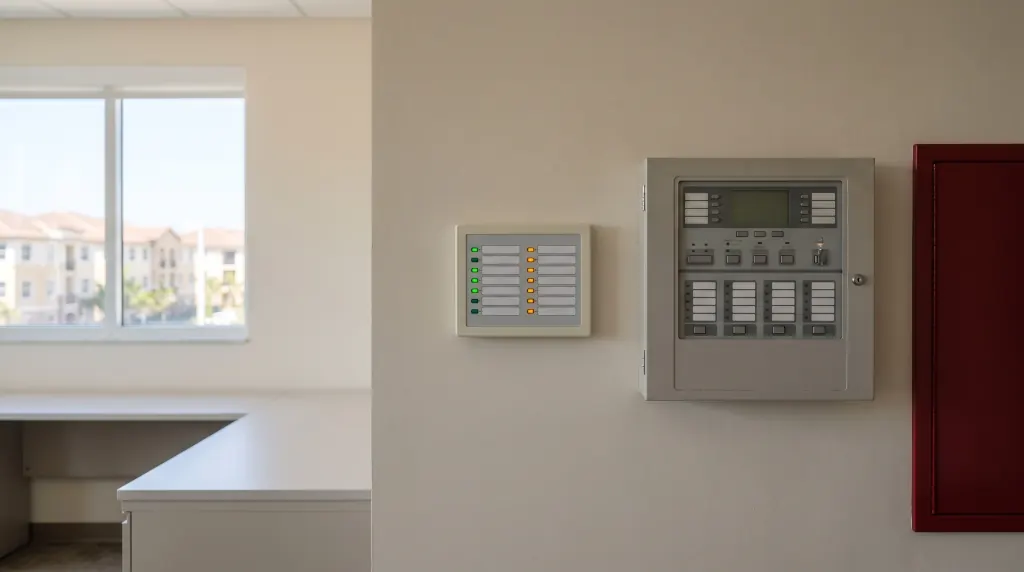
The system must be monitored by a listed fire alarm control unit, or by an audible signal at a constantly attended location, and the model code lists eight supervisory signals, such as donor antenna failure and low battery (IFC 2021 510.4.2.5). That means the fire alarm contractor has to program and test those points before the radio acceptance test. Put both contractors on the same schedule and make one of them responsible for the tie-in in writing.
The acceptance test
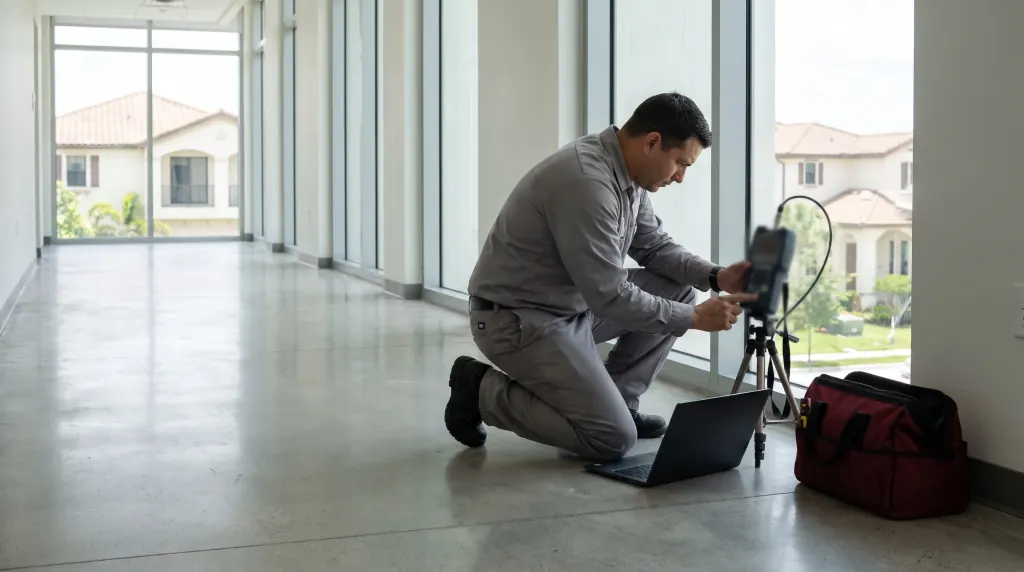
The acceptance test is what most COs wait on (IFC 2021 510.5.4):
- Each floor is divided into 20 roughly equal test areas.
- More than one failed area fails the floor. If exactly two areas fail, the floor may be redivided into 40 areas, with up to two non-adjacent failures allowed.
- The tester uses a calibrated radio of the model the fire department uses, on the department's system.
- Amplifier gain values are recorded and kept by the owner.
- A spectrum analyzer checks the booster for oscillation.
Coverage must reach 95 percent of all areas and 99 percent of critical areas on each floor under the model code (IFC 2021 510.4.1), though your fire department may use its own numbers. On test day, have every room unlocked, including stairs, the fire pump room and elevator lobbies, and have the installer and fire alarm contractor on site. If the test fails, see failed a radio coverage test. For the full sequence, see BDA system testing.
What to ask the fire marshal
Send these in writing so the answers are on record:
- Which document sets the signal levels and critical areas for this building?
- Can the acceptance test be scheduled before final finishes, or only after?
- What does a TCO need for radio coverage, if one is possible here?
- Who must witness the test, and how far ahead must it be booked?
- What paperwork closes the radio permit: test report, as-builts, the license holder's letter?
If the original installer has dropped out, see permit expired or installer quit.
Get quotes to clear the test
The form below sends your request to up to 3 licensed installers who serve your area. They reach you by email, or by phone only if you choose calls.
Free for owners, boards and managers
Get up to 3 quotes to clear the radio test
Two minutes. We send your request to installers who work in your county and know your fire marshal.
- Up to 3 licensed installers who serve your area may contact you. Never more than 3.
- By email, or by phone call only if you choose calls below.
- No texts, no robocalls, and we never sell your request to a marketing list.
- Owners never pay us. Installers pay ERRCSCheck for the introduction.
- If no installer covers your area, we tell you within 2 business days and send your local requirements instead.
ERRCSCheck is a private company, not a government agency or fire department.
Request received
Thank you. Up to 3 licensed installers who serve your area will contact you, usually within 2 business days.
Next step
Take the board a plan, not just a problem
Ask for up to 3 quotes from vetted installers who serve your area, or start with a one-page brief the board can read before the next meeting. Free for owners, boards and managers. No texts, no cold calls.
Questions people ask
Can we get a temporary certificate of occupancy while the radio system is finished?
Sometimes, but it is a local decision. Phoenix, for example, says a temporary certificate of occupancy may be issued case by case (Phoenix Explanatory Policy, Emergency Responder Radio Coverage). Broward's code holds the certificate of occupancy or completion until the system is approved (FBC Broward 118.1.4). Ask your building official and fire marshal in writing what a TCO would need.
Does every new building need an amplifier?
No. A new building needs approved coverage (IFC 2021 510.1). If the test shows the building already meets the signal levels, no amplification system is required (IFC 2021 510.4.2.1). In Florida, if the fire marshal finds the public safety signal inadequate at the outside of the building, no system or assessment is required (F.S. 633.202(18)(e)).
When should the signal test happen on a new building?
Ask the fire marshal, because the coverage test has to reflect the finished building. Walls, glass and below-grade floors all change the signal. Many teams run an early survey to plan the design and pathways, then the formal acceptance test once the building is closed in and the system is installed.
Is ERRCSCheck part of the fire department or building department?
No. ERRCSCheck is a private company, not a government agency. Only your building official and fire marshal can release a certificate of occupancy.
Sources
Primary documents we read for this page. Rules change; confirm with your fire marshal (AHJ).
- International Fire Code 2021, Section 510 (text as published by the City of Eaton), City of Eaton, reproducing the ICC International Fire Code
- Florida Statutes 2026, section 633.202, subsection (18), The Florida Senate
- BORA ERCES Guidelines, revised 2021-10-14 (archived copy; broward.org blocks automated access), Broward County Board of Rules and Appeals
- 47 CFR 90.219, Use of signal boosters, Electronic Code of Federal Regulations
- Fire Prevention Section Explanatory Policy Manual 2026, Emergency Responder Radio Coverage (effective January 1, 2026), City of Phoenix Fire Department
- Emergency Responder Communication Coverage (ERCC) Guideline, Form CE-1350 (revised July 2025), City of Houston
Related
Something happened with your building's radio coverage. Start here.
Plain next steps for owners, condo boards and managers: failed coverage test, fire marshal order, expired permit, CO on hold or a board that needs quotes.
Your building failed a radio coverage test. Here is what to do next.
Failed an ERRCS signal or grid test? What the result means, the fix options from antennas to a full BDA, how long Florida gives you, and how to get bids.
Your ERRCS permit expired or the installer walked away. Here is how to finish.
The radio coverage permit lapsed or the installer stopped answering mid-job. How to get the permit file, collect your paperwork and hire a new contractor.
How a BDA system is tested
What happens in a BDA acceptance test and an annual BDA test under the fire code: grid testing, gain checks, battery load tests, oscillation checks and reports.