BDA systems
BDA systems for firefighter radio coverage
A BDA system is the equipment that carries fire and police radio into a building, so firefighters can talk from the stairwells, the garage and the top floor. Fire codes call the requirement ERRCS. Here are the parts, the rules they must meet and who may install them.
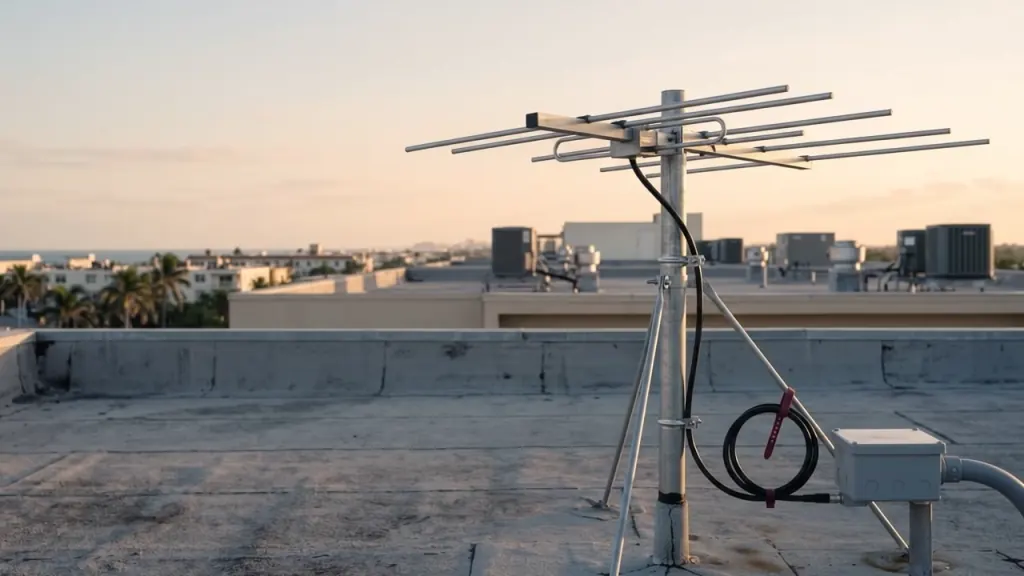
What a BDA system does
Fire department radios often fail inside large or dense buildings. Concrete, steel, low-emissivity glass and basements block the signal. A BDA system fixes that with three parts working together:
- A donor antenna on the roof talks to the public safety radio tower.
- The bi-directional amplifier boosts the signal in both directions: down to radios inside the building, and up from those radios back to the tower.
- Indoor antennas, connected by coaxial or fiber cable, spread the signal through the floors.
The model fire code does not require every building to install one. It requires coverage. A building that already has good enough signal inside needs no amplifier. A building that cannot support the required coverage must add "systems and components to enhance the radio signals" until it does (IFC 2021 510.4.2.1).
How it works
From the tower to a firefighter's radio, and back
- Public safety radio towerThe fire department's radio network outside. Coverage inside is judged against the signal measured at the outside of the building.IFC 2021 510.1
- Donor antenna on the roofAimed at the tower and permanently fixed, so it stays aligned.IFC 2021 510.5.1
- Bi-directional amplifier (BDA)Boosts the signal both ways: down to radios inside, and up from those radios back to the tower.IFC 2021 510.4.2.1; 47 CFR 90.219(a)
- Standby batteryRuns the system at 100 percent for at least 12 hours when the power fails.IFC 2021 510.4.2.3
- Cable riser and indoor antennasCarry the signal to every floor, with enough antennas to reach the far corners.IFC 2021 510.4.2.8
- A firefighter's radioNow works in the stairwell, the garage and rooms behind concrete, and reaches command outside.
Illustration
Where firefighter radios go quiet
Concrete, steel, glass and earth block radio signals. A system brings the signal in from the roof and spreads it through the building. Drag the divider.
The parts the code asks for
| Part | What the model code says | Citation |
|---|---|---|
| Listed equipment | Equipment must be listed to UL 2524 | IFC 2021 510.4 |
| Signal booster cabinet | NEMA 4-type waterproof cabinet | IFC 2021 510.4.2.4 item 1 |
| Battery cabinet | NEMA 3R or higher-rated cabinet | IFC 2021 510.4.2.4 item 2 |
| Standby power | Dedicated batteries, or 2-hour batteries plus the building generator, able to run the system at 100% for at least 12 hours | IFC 2021 510.4.2.3 |
| Antenna isolation | Donor-to-inside-antenna isolation at least 20 dB greater than system gain | IFC 2021 510.4.2.4 item 4 |
| Oscillation control | Built-in oscillation detection and control on active RF devices | IFC 2021 510.4.2.4 item 5 |
| Monitoring | Watched by a listed fire alarm control unit, or an audible signal at a constantly attended location where approved | IFC 2021 510.4.2.5 |
| Donor antenna mounting | Permanently fixed, or on an approved sled with a "do not move" sign | IFC 2021 510.5.1 |
The monitoring list in the model code has eight supervisory signals: loss of AC power, battery charger failure, donor antenna malfunction, failure of active RF devices, low battery at 70 percent reduction of capacity, failure of critical components, loss of the link to the fire alarm system, and oscillation (IFC 2021 510.4.2.5).
Local codes often go further. San Francisco requires the booster and its UPS in a 2-hour rated room and a remote connection that lets the City shut off the uplink (SFFD AB 2.01 Addendum G, II.G and II.N). Pierce County, Washington approves only Class A boosters (Pierce County ERRCS Handout). Check your local requirements page before anyone orders equipment.
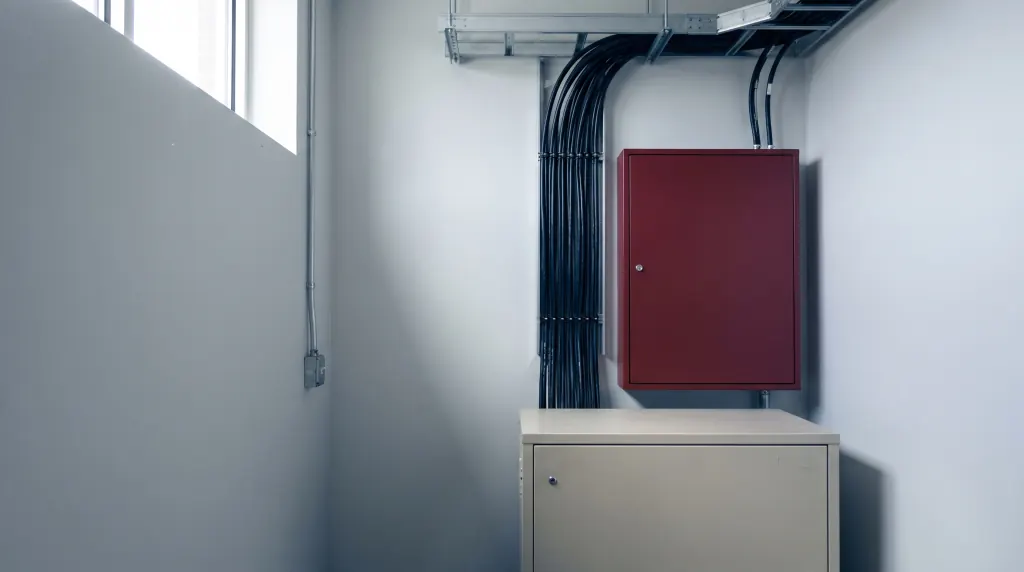
The equipment
What the code asks for, part by part
- Donor antenna feedCable up to the roof antenna, which must be permanently fixed or on an approved sled with a do-not-move sign.IFC 2021 510.5.1
- Signal booster (BDA)Listed to UL 2524, FCC certified, in a NEMA 4-type cabinet, with built-in oscillation control.IFC 2021 510.4, 510.4.2.4 items 1, 3, 5
- Battery cabinetNEMA 3R or better. Runs the whole system at 100 percent for at least 12 hours.IFC 2021 510.4.2.3, 510.4.2.4 item 2
- Dedicated annunciatorShows the system's status where firefighters look. Required by some fire departments and NFPA 1225.NFPA 1225 (2022) 18.14.2; SFFD AB 2.01 Addendum G, II.J
- Fire alarm control panelWatches the system and reports eight supervisory signals, from loss of power to oscillation.IFC 2021 510.4.2.5
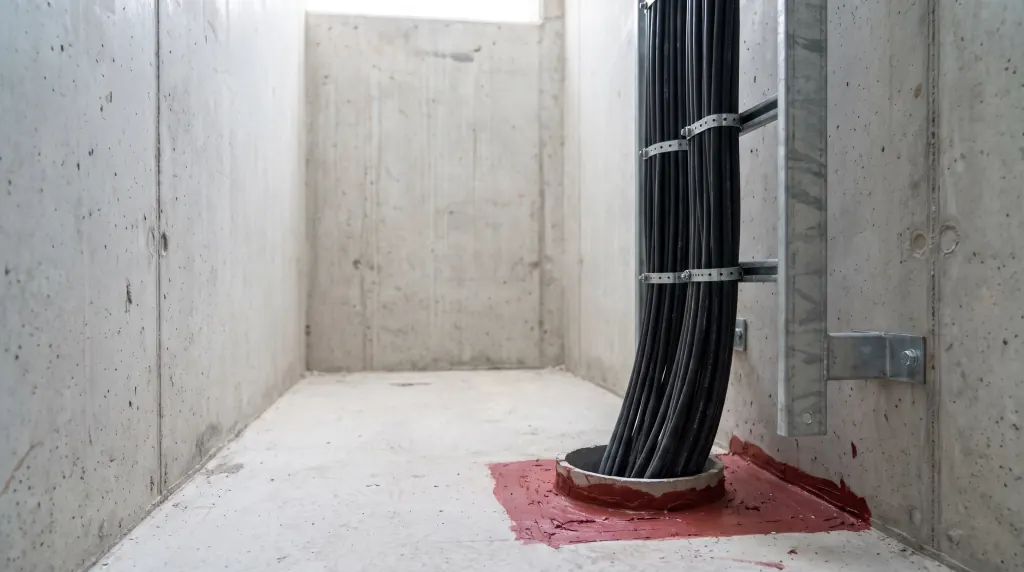
- Coax and splittersCarry the signal from the booster into the building's cable pathways.IFC 2021 510.4.2.8
- Indoor antennasEnough of them, close enough together, to cover 95 percent of each floor and 99 percent of critical areas.IFC 2021 510.4.1, 510.4.2.8
The signal it has to deliver
Under the 2021 model code, a building has acceptable coverage when 95 percent of all areas and 99 percent of critical areas on each floor meet the signal requirements (IFC 2021 510.4.1). The inbound signal must be at least -95 dBm and give a Delivered Audio Quality (DAQ) of 3.0 or an equivalent signal-to-noise measure (IFC 2021 510.4.1.1).
Those are model numbers. Fire departments change them. San Diego and Palo Alto ask for DAQ 3.4, and Los Angeles' Requirement #105 uses 90 percent for general areas. Your fire code official's technical criteria document decides (IFC 2021 510.4.2.2).
How coverage is tested
One floor, 20 squares, a radio check in each
- 20 test areas per floorEach floor is divided into a grid of 20 roughly equal areas.IFC 2021 510.5.4
- One test spot per areaA spot near the center stands for the whole area. No extra spots after it is chosen.
- One failed area is allowedMore than one failed area fails the floor. With exactly two, the floor may be re-divided into 40 areas, and up to two non-adjacent failures are allowed.IFC 2021 510.5.4
- Critical areas count moreTypical model-code targets: 95 percent of all areas and 99 percent of critical areas such as stairs and elevator lobbies. Your fire marshal sets the numbers that apply to you.IFC 2021 510.4.1
Illustration: 19 of 20 areas pass, so this floor passes. Some fire departments use other numbers; Miami-Dade, for example, stops an acceptance test below 90 percent of general areas.
Federal rules: consent and registration
A BDA rebroadcasts radio frequencies that belong to a licensee, usually the city, county or regional radio authority. Federal rules set three conditions that matter to owners:
- Consent. A building owner or contractor who is not the licensee must get the licensee's express consent before operating a booster, and keep it in a recordable format for the FCC (47 CFR 90.219(b)(1)(i)). Florida law repeats this for every new system or modification (F.S. 633.202(18)(d)).
- Registration. Class B signal boosters, those with a passband wider than 75 kHz, must be registered in the FCC signal booster database (47 CFR 90.219(a) and (d)(5)).
- Weak signal areas only. Boosters may improve coverage in weak signal areas but may not extend a station's normal range, and each retransmitted channel is limited to 5 watts ERP (47 CFR 90.219(d)(1) to (d)(3)).
Who can design and install it
The model code requires the designer and lead installer to hold a valid FCC general radio operator license and in-building system training from an approved organization or the equipment manufacturer, unless the fire code official accepts other proof of skill (IFC 2021 510.5.3).
Some cities add more:
- Houston requires ERCC plans sealed by a Texas Professional Engineer.
- Phoenix requires NICET In-Building Public Safety Communications certification for designers and lead installers.
Each city page lists its own rules.
Next steps for owners
- Check whether your building likely needs coverage, with the source for each answer.
- Read your state or local requirements for signal levels, bands and permit steps.
- Learn what a system costs and how it is tested.
- When you are ready, request up to 3 quotes. Your request goes to up to 3 vetted installers who serve your area. We send no texts and make no cold calls.
Confirm with your fire marshal (AHJ) before you design, permit or test anything.
Next step
Take the board a plan, not just a problem
Ask for up to 3 quotes from vetted installers who serve your area, or start with a one-page brief the board can read before the next meeting. Free for owners, boards and managers. No texts, no cold calls.
Questions people ask
Is a BDA system the same thing as an ERRCS?
In practice, yes. The International Fire Code describes the requirement as in-building, two-way emergency responder communication coverage and uses "signal boosters" for the amplifiers. Building owners and installers usually call the whole system a BDA system after its main part, the bi-directional amplifier. See ERCES, ERRCS and other names.
Does a BDA system have to be registered with the FCC?
A Class B signal booster (one with a passband wider than 75 kHz) must be registered in the FCC signal booster database. Anyone who is not the radio licensee also needs the licensee's express consent, kept in a recordable format (47 CFR 90.219(b)(1)(i) and (d)(5)).
Who decides what signal strength my building needs?
Your fire code official. The model fire code sets a baseline, then says the fire code official keeps a document with the frequencies, radio sites and other technical criteria for system design (IFC 2021 510.4.2.2). In Florida the statute gives the local authority that job directly (F.S. 633.202(18)(a)).
Sources
Primary documents we read for this page. Rules change; confirm with your fire marshal (AHJ).
- International Fire Code 2021, Section 510 Emergency Responder Communication Coverage (text as published by the City of Eaton), City of Eaton, reproducing the ICC International Fire Code
- 47 CFR 90.219, Use of signal boosters, Electronic Code of Federal Regulations
- WAC 51-54A-0510, Emergency responder communication coverage, Washington State Legislature
- Florida Statutes 2026, section 633.202, subsection (18), The Florida Senate
- ERRCS Handout (effective 11/15/2022), Pierce County Fire Prevention Bureau
- Administrative Bulletin 2.01 (2025), Addendum G, San Francisco Fire Department
Related
What a BDA system costs, part by part
What drives the cost of a BDA system for firefighter radio coverage, which code rules add cost, and one reported high-rise price, with sources.
How a BDA system is tested
What happens in a BDA acceptance test and an annual BDA test under the fire code: grid testing, gain checks, battery load tests, oscillation checks and reports.
What is ERRCS?
ERRCS means in-building radio coverage for firefighters and police. Why fire codes require it, who sets the rules, who pays, and what owners must do.
Public safety DAS, BDA and cellular DAS
How a public safety DAS relates to a BDA, why it is not the same as a cellular DAS, and the federal and local rules on sharing equipment between them.
Does the radio coverage rule apply to your building?
Answer a few questions about your building and see what the published fire code rules say for your jurisdiction, with the source for every line.