Plain-English guide
What is ERRCS?
ERRCS is the fire code rule that firefighters' radios must work inside your building, from the stairwells to the garage. Here is what it means, why buildings are being cited now, and what an owner does next.
The short version
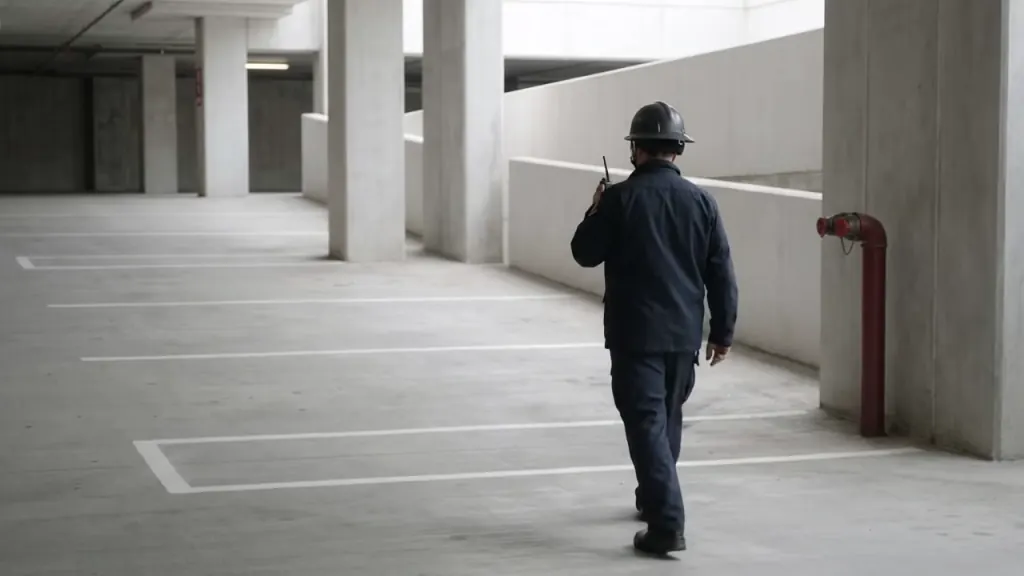
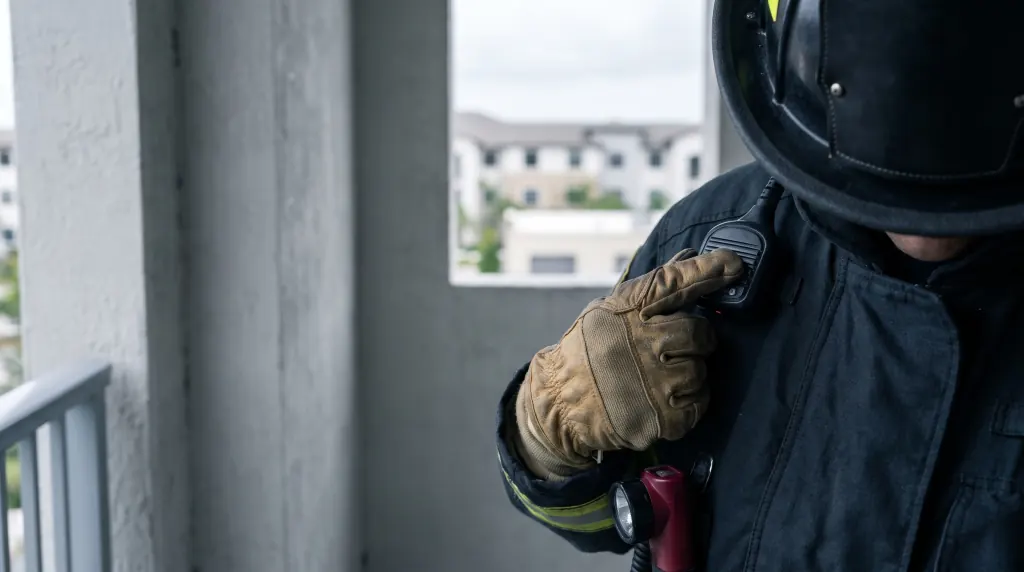
When firefighters go into a building, they talk to each other and to command outside by radio. Thick walls, steel, glass coatings, stairwells and basements can block that signal. ERRCS rules make sure the radios still work. The model fire code says a building has acceptable coverage when signal measurements meet the requirements in 95 percent of all areas and 99 percent of critical areas on each floor (IFC 2021 510.4.1).
If a building already has that coverage, nothing needs to be installed. If it does not, the owner must add equipment to boost the signal, usually a BDA system (bi-directional amplifier plus antennas) or a public safety DAS (IFC 2021 510.4.2.1).
How it works
From the tower to a firefighter's radio, and back
- Public safety radio towerThe fire department's radio network outside. Coverage inside is judged against the signal measured at the outside of the building.IFC 2021 510.1
- Donor antenna on the roofAimed at the tower and permanently fixed, so it stays aligned.IFC 2021 510.5.1
- Bi-directional amplifier (BDA)Boosts the signal both ways: down to radios inside, and up from those radios back to the tower.IFC 2021 510.4.2.1; 47 CFR 90.219(a)
- Standby batteryRuns the system at 100 percent for at least 12 hours when the power fails.IFC 2021 510.4.2.3
- Cable riser and indoor antennasCarry the signal to every floor, with enough antennas to reach the far corners.IFC 2021 510.4.2.8
- A firefighter's radioNow works in the stairwell, the garage and rooms behind concrete, and reaches command outside.
Illustration
Where firefighter radios go quiet
Concrete, steel, glass and earth block radio signals. A system brings the signal in from the roof and spreads it through the building. Drag the divider.
Where the rule comes from
- The model code. Section 510 of the International Fire Code requires approved in-building, two-way emergency responder communication coverage in all new buildings, based on the existing signal measured outside the building. It does not require the city to improve its own radio system (IFC 2021 510.1).
- Existing buildings. Section 510.2 points existing buildings to Chapter 11 of the code. Washington's version of that chapter, for example, requires existing buildings other than Group R-3 to add coverage when an existing wired system cannot be repaired or is replaced, or within a time frame the local government sets (WAC 51-54A-1103, 1103.2).
- State law. Some states write their own rule. Florida's statute requires all new and existing buildings to meet the minimum signal strength the local fire marshal sets, with listed exemptions and high-rise deadlines (F.S. 633.202(18)).
- Your local fire marshal. The fire code official keeps the technical document with frequencies, radio sites and design criteria (IFC 2021 510.4.2.2), and many cities publish their own amendments. That is why we publish rules by state and city.
Who sets the rule
Four layers decide what your building owes
- Layer 1The model codeIFC Section 510, and the NFPA standard it points to (NFPA 1221, now NFPA 1225). Sets the baseline: coverage, equipment, testing.IFC 2021 510; NFPA 1225 (2022)
- Layer 2Your stateStates adopt the code and some write their own law. Florida's statute says who must comply, lists exemptions and set the high-rise dates.F.S. 633.202(18)
- Layer 3Your fire marshal (AHJ)Sets the signal level, the radio bands and the permit steps, and keeps a technical criteria document.F.S. 633.202(18)(a); IFC 2021 510.4.2.2
- Layer 4Your buildingA signal test shows whether the inside meets that level. A system is needed only where it falls short.IFC 2021 510.4.2.1; F.S. 633.202(18)(c)1
Why owners are hearing about it now
Retrofit rules for existing buildings have arrived in several places:
- Florida. Existing high-rises had to apply for a permit by January 1, 2024 and comply by January 1, 2025 (F.S. 633.202(18)(a)).
- Fort Lauderdale. After those dates the city cited 69 of its 484 high-rises for weak radio signals, according to the Sun Sentinel (via Firehouse, November 2025).
- San Diego and San Francisco. Existing high-rises without a wired fire department phone system must test, and install a system within 3 years if they fail (SDFD ERRCS guideline II.B.3; SFFD AB 2.01 Addendum G, I.D).
If your board just heard about this, our page for condo owners and boards covers what to do next.

Florida deadline
The Florida dates have passed
Every date here comes from the statute or rule cited under it.
Florida compliance date for existing high-rises
Existing high-rise buildings had to apply for a permit by January 1, 2024 and meet the minimum radio signal strength by January 1, 2025. F.S. 633.202(18)(a)
After a notice of violation, the owner gets at least 1 year to finish the work. F.S. 633.202(18)(g)
What the owner is responsible for
| Obligation | Model code | Citation |
|---|---|---|
| Provide approved coverage where required | Yes | IFC 2021 510.1, 510.2 |
| Get a construction permit to install or modify a system | Yes | IFC 2021 510.3 |
| Have the system acceptance tested after installation | Yes | IFC 2021 510.5.4 |
| Keep amplifier gain records on file | Yes | IFC 2021 510.5.4 item 6 |
| Test it every year and after structural changes | Yes | IFC 2021 510.6.1 |
| Pay for changes if frequencies change | Yes | IFC 2021 510.6.2 |
| Fix or remove other amplifiers that interfere | Yes | IFC 2021 510.6.3 |
| Let the agency field test at any reasonable time | Yes | IFC 2021 510.6.4 |
On top of the fire code, federal rules require the radio licensee's consent before a non-licensee operates a signal booster, and registration of Class B boosters with the FCC (47 CFR 90.219(b)(1) and (d)(5)).
What to do next
- Run the building checker. Every answer cites its source.
- Read Does my building need ERRCS? for how the triggers differ by city.
- If you have a notice from the fire marshal, read what to do after a citation.
This is guidance, not engineering advice. Confirm with your fire marshal (AHJ).
Next step
Take the board a plan, not just a problem
Ask for up to 3 quotes from vetted installers who serve your area, or start with a one-page brief the board can read before the next meeting. Free for owners, boards and managers. No texts, no cold calls.
Questions people ask
Is ERRCS required by federal law?
No. The requirement comes from the fire code your state or city adopts, usually Section 510 of the International Fire Code or a state version of it. Federal rules (47 CFR 90.219) govern how signal boosters may operate once installed.
Who pays for an ERRCS?
The building owner. The model code also makes the owner pay to modify or expand the system if radio frequencies change (IFC 2021 510.6.2).
Does ERRCS cover police and EMS radios too?
It covers the public safety radio systems your jurisdiction uses for emergency response. Which agencies and bands are included is set locally; Seattle, for example, checks Seattle Police channels during its fire department test (SFD CAM 5123).
Sources
Primary documents we read for this page. Rules change; confirm with your fire marshal (AHJ).
- International Fire Code 2021, Section 510 (text as published by the City of Eaton), City of Eaton, reproducing the ICC International Fire Code
- WAC 51-54A-1103, Section 1103.2, Emergency responder communication enhancement in existing buildings, Washington State Legislature
- Florida Statutes 2026, section 633.202, subsection (18), The Florida Senate
- 47 CFR 90.219, Use of signal boosters, Electronic Code of Federal Regulations
- Fort Lauderdale cites 69 high-rises with weak radio signals (South Florida Sun Sentinel, republished by Firehouse, November 7, 2025), Firehouse
- Client Assistance Memo 5123, Emergency Responder/Public Safety Radio Amplification Systems Using PSERN (November 2024), Seattle Fire Department
- San Diego Fire-Rescue ERRCS guideline (9/22/23), City of San Diego
- Administrative Bulletin 2.01 (2025), Addendum G, San Francisco Fire Department
Related
Does my building need ERRCS?
How to tell whether your building needs emergency responder radio coverage, the questions that decide it, and a side-by-side table of triggers in the cities we cover.
BDA systems for firefighter radio coverage
What a BDA (bi-directional amplifier) system is, the parts it needs, the FCC and fire code rules it must meet, and how owners find their local requirements.
ERCES, ERRCS, BDA and the other names for firefighter radio coverage
ERCES, ERRCS, ERCC, ERRS, BDA and public safety DAS all describe in-building radio coverage for firefighters. Which code or city uses which name, and why it matters.
IFC Section 510, section by section
A plain-English walk through International Fire Code Section 510 (2021) on emergency responder radio coverage, plus Section 1103.2 for existing buildings.