For condo owners and boards
Your building got an ERRCS notice. Here is what it means.
ERRCS is the fire code rule that says firefighters' radios must work inside your building. It is a real safety rule with real dates, and it is fixable. This page explains it in plain words and gives you something to take back to the board.
Why boards are hearing about it now
- Florida compliance dateJan 1, 2025 PassedExisting high-rises had to meet the minimum radio signal strength.F.S. 633.202(18)(a)
- After a notice of violationAt least 1 yearto finish a required retrofit. The date on your notice controls.F.S. 633.202(18)(g)
- Reported cost, Fort Lauderdale high-rises$250,000 or morefor a radio booster system, as reported in November 2025.Sun Sentinel, via Firehouse
What ERRCS means in plain English
ERRCS stands for Emergency Responder Radio Coverage System. Strip away the letters and it means one thing: when firefighters are inside your building, their radios have to work.
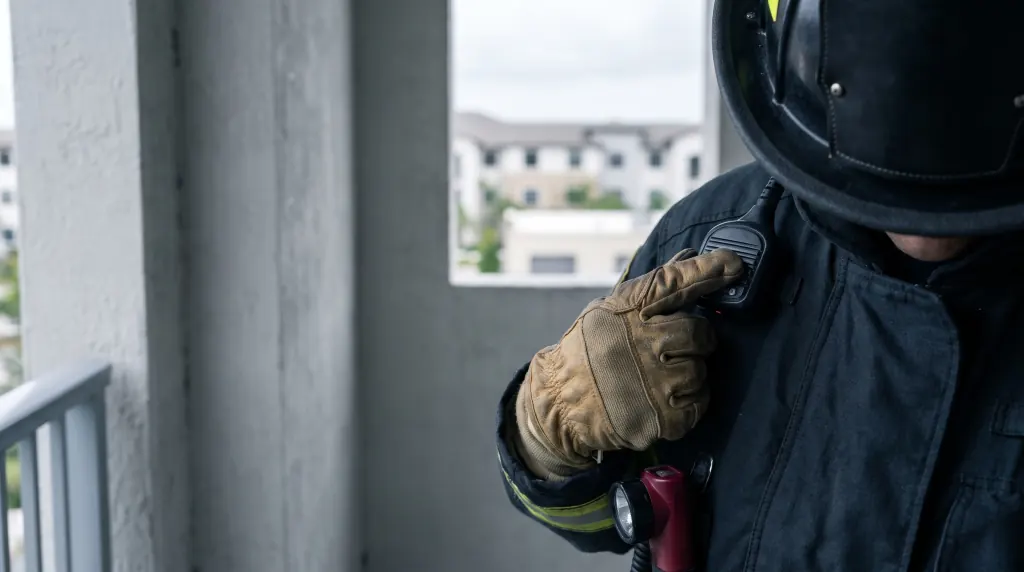
Concrete, steel, coated glass and below-ground floors can block radio signals. Most buildings never notice, because residents use cell phones. Firefighters use their own public safety radios, and those can drop out in stairwells, garages and elevator areas.
The fire code says a building needs approved radio coverage inside, measured against the signal outside (IFC 2021 510.1). If the signal inside is already good enough, nothing is installed. If it is not, the building adds equipment, usually called a BDA system (a radio amplifier plus antennas), to carry the signal in (IFC 2021 510.4.2.1).
You may also see ERCES, ERCC or "public safety DAS" in letters and quotes. They describe the same requirement. Our page on the different names maps them.
How it works
From the tower to a firefighter's radio, and back
- Public safety radio towerThe fire department's radio network outside. Coverage inside is judged against the signal measured at the outside of the building.IFC 2021 510.1
- Donor antenna on the roofAimed at the tower and permanently fixed, so it stays aligned.IFC 2021 510.5.1
- Bi-directional amplifier (BDA)Boosts the signal both ways: down to radios inside, and up from those radios back to the tower.IFC 2021 510.4.2.1; 47 CFR 90.219(a)
- Standby batteryRuns the system at 100 percent for at least 12 hours when the power fails.IFC 2021 510.4.2.3
- Cable riser and indoor antennasCarry the signal to every floor, with enough antennas to reach the far corners.IFC 2021 510.4.2.8
- A firefighter's radioNow works in the stairwell, the garage and rooms behind concrete, and reaches command outside.
Why the fire marshal cares
This is a firefighter-safety rule. During a fire, crews spread out through the building and talk to each other and to the commander outside by radio. A dead spot in a stairwell or garage is a place where a firefighter cannot be heard.
The model code sets the bar at coverage in 95 percent of all areas and 99 percent of critical areas on each floor (IFC 2021 510.4.1). Critical areas are named locally. Miami-Dade's list, for example, includes stair enclosures, elevator lobbies, fire pump rooms and fire command centers (Miami-Dade BDA guidelines).
Ordinary building work can change the signal. In Fort Lauderdale, a city commissioner described a building that failed after it installed high-impact windows (Sun Sentinel via Firehouse, November 2025). Many Florida condos have done exactly that kind of upgrade.
Illustration
Where firefighter radios go quiet
Concrete, steel, glass and earth block radio signals. A system brings the signal in from the roof and spreads it through the building. Drag the divider.
The deadlines that apply
In Florida, the dates come from state law, F.S. 633.202(18). Most of them have already passed.
| Date or window | What it means | Citation |
|---|---|---|
| January 1, 2024 | Existing high-rises not in compliance had to apply for a permit and show they would comply by 2025 | F.S. 633.202(18)(a) |
| January 1, 2025 | Existing high-rises had to meet the minimum radio signal strength | F.S. 633.202(18)(a) |
| At least 1 year after a notice | If the fire marshal cites the building and requires a retrofit, the owner gets at least a year from the notice of code violation to finish | F.S. 633.202(18)(g) |
| At least 180 days' notice | If the local radio system changes in a way that forces changes to existing systems | F.S. 633.202(18)(f) |
| Every 3 or 5 years at most | How often the fire marshal may require a new coverage assessment (3 years for high-rises and buildings over 12,000 sq ft; 5 for others; with exceptions) | F.S. 633.202(18)(c)2 |
| December 31, 2026 (proposed) | Proposed date for the 9th edition Florida Fire Prevention Code, with in-building radio rules pointing to NFPA 1225. Not final. | Notice of Proposed Rule 69A-60.003 |
The date on your notice controls. If you have one, write it down today and count the months.
Some buildings are exempt. Florida exempts (F.S. 633.202(18)(h)):
- one- and two-family homes and townhouses;
- buildings under 12,000 square feet with no underground areas;
- low-rise apartments under three stories with direct exterior exits;
- some wood-frame apartment buildings.
The statute says "apartments"; condominium buildings are normally classed as apartment occupancies. Confirm with your fire marshal. And if the fire marshal finds the public safety signal weak even outside the building, no system or assessment is required (F.S. 633.202(18)(e)).
Not in Florida? Rules and dates are local. Find yours on the requirements pages.
Florida deadlines
The dates in Florida's statute, and the clocks that follow
- Permit application dueExisting high-rises not yet in compliance had to apply for the permit and show they would comply by January 1, 2025.F.S. 633.202(18)(a)
- Compliance dateExisting high-rise buildings, including high-rise apartments, had to meet the minimum radio signal strength.F.S. 633.202(18)(a)
- Proposed 9th edition fire codeThe proposed Florida Fire Prevention Code points to NFPA 1225 for the signal rule. Proposed, not yet in force.Notice of Proposed Rule 69A-60.003
Clocks that start from an event
Your notice
How long do we have?
Every date here comes from the statute or rule cited under it.
In Florida, after the fire marshal issues a notice of code violation, the owner gets at least 1 year to complete a required retrofit. The date written on your notice controls; it may give you more. F.S. 633.202(18)(g)
What it may cost
There is no public price list, and nobody can price your building over the phone. The figures we can source come from one news report on Fort Lauderdale high-rises (Sun Sentinel via Firehouse, November 2025):
| What was reported | Amount |
|---|---|
| What the article said systems can cost | $250,000 or more |
| Figure given to one condo association president | $275,000 |
| A city commissioner's example (the building with new windows) | $200,000 |
| Per owner at $250,000, for 250 unit owners (a retired fire chief's math) | about $1,000 |
| Per owner at $250,000, for 25 unit owners | about $10,000 |
Those are high-rise numbers from one city. Your building may cost far less, or more. Fire department fees are on top: Miami-Dade, for example, charges $281.48 per inspector per hour for the signal verification and acceptance test (Implementing Order 04-123, effective 10/01/2025). After installation, the system must be tested every year (IFC 2021 510.6.1), so budget for that too.
The only way to a real number is a signal test and written bids on the same scope. Our sister site keeps the full cost breakdown with published fees.
Sourced figures only
What it may cost
We print a price only when we can trace it to a published record. Each figure links to its source.
Reported high-rise figures, Fort Lauderdale
Source: Fort Lauderdale cites 69 high-rises with weak radio signals, South Florida Sun-Sentinel (Susannah Bryan), republished by Firehouse, Nov. 7, 2025. These are one city's high-rise data points, not a typical price.
$1,000 per unit if split equally
- $1,000 per owner at $250,000 with 250 owners (a retired fire chief quoted in the article).
- $10,000 per owner at $250,000 with 25 owners (a retired fire chief quoted in the article).
An equal split is arithmetic, not advice. How an association shares costs depends on its governing documents and state law; ask the association's attorney.
We have not found a verifiable published figure for smaller buildings. Get at least three written quotes.
Every cost the rules create
| When | What you pay for | Required by |
|---|---|---|
| Before you buy | Signal test or benchmark survey | Houston CE-1350 (test before any BDA); Phoenix policy (benchmark RF test) |
| Before you buy | Engineering design; some cities require a licensed engineer | IFC 2021 510.4.2.7; Houston CE-1350 (Texas PE); Phoenix policy (Arizona PE certificate) |
| Install | Equipment, antennas, cable, fire-rated pathways, batteries, monitoring | IFC 2021 510.4 to 510.4.2.8 |
| Install | Construction permit and plan review | IFC 2021 510.3 |
| Install | Acceptance test, sometimes by an independent third party | IFC 2021 510.5.4; Palo Alto 510.5.3 |
| Every year | Annual inspection and test, plus a report to the fire department | IFC 2021 510.6.1 |
| As needed | Repairs within local deadlines | LAFD Requirement #105 (evaluation in 24 hours, repair in 5 working days for service-affecting failures; approved 8/7/2018, confirm the current version with LAFD) |
| As needed | Changes when frequencies change | IFC 2021 510.6.2 (owner's expense); in Florida, at least 180 days' notice, F.S. 633.202(18)(f) |
| As needed | Retest after structural changes | IFC 2021 510.6.1 |
| Florida only | Coverage re-assessment no more than every 3 or 5 years, depending on the building | F.S. 633.202(18)(c)2 |
No dollar amounts here on purpose: they depend on your building. Ask each installer to price these lines separately.
Published fire department fees
| Fee | Fire department | Amount | Effective |
|---|---|---|---|
| Signal strength verification and system acceptance test (per inspector per hour) | Miami-Dade County | $281.48 | Oct 1, 2025 |
| Re-acceptance test for existing systems | Miami-Dade County | $311.59 | Oct 1, 2025 |
| Equipment installation inspection, 1 to 6 devices | Miami-Dade County | $210.63 | Oct 1, 2025 |
| Equipment installation inspection, 7 to 100 devices | Miami-Dade County | $351.47 | Oct 1, 2025 |
| Each device over 100 (each device over 100) | Miami-Dade County | $2.00 | Oct 1, 2025 |
| First or second re-inspection of a fire safety system | Miami-Dade County | $98.46 | Oct 1, 2025 |
| Third or later re-inspection | Miami-Dade County | $194.44 | Oct 1, 2025 |
| Plan review, bi-directional amplifier | Fort Myers Beach Fire District | $376.00 | Sep 1, 2023 |
| Bi-directional amplifier acceptance testing | Fort Myers Beach Fire District | $188.00 | Sep 1, 2023 |
| Radio signal testing | Fort Myers Beach Fire District | $50.00 | Sep 1, 2023 |
Official fees, not vendor prices. Miami-Dade lists "no contractor or unable to gain access on inspector's arrival" among the reasons a re-inspection is charged. Check your own fire department's schedule.
Quotes go to up to 3 vetted installers who serve your area. No texts, no cold calls.
What the board does next
Nothing here has to be decided tonight. Here is a calm order of work for the next few weeks.
- Find the paper. Collect the notice, any fire marshal letters, old test reports and permits. Deadlines and scope are usually written there.
- Name one contact. Pick one person, a manager or a board member, to speak for the building. Fire departments, installers and the radio licensee all need one point of contact.
- Check for an exemption. Run the building checker. It applies Florida's published exemptions and cites each one.
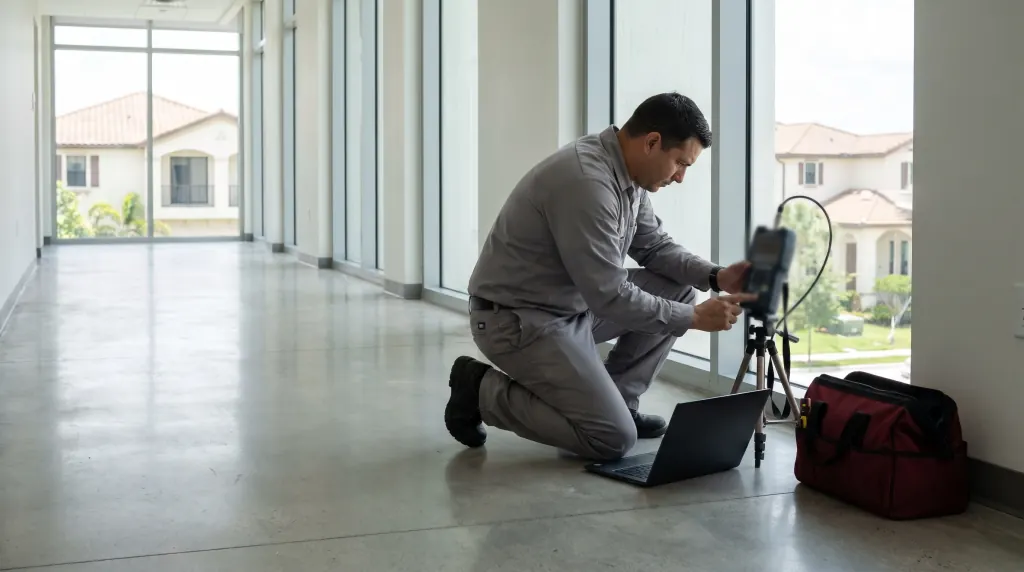
- Get a signal test. A test shows whether you need a system at all, and how big. Ask for a written report with a floor-by-floor grid.
- Ask the fire department for its technical criteria. The fire code official keeps a document with frequencies and design requirements (IFC 2021 510.4.2.2).
- Get written bids on the same scope. Comparable bids are easier to judge. You can request up to 3 quotes.
- Check credentials. The designer and lead installer need an FCC general radio operator license and in-building system training at minimum (IFC 2021 510.5.3).
- Get the radio licensee's consent. The agency that owns the radio channels must consent before a booster operates, kept in writing (47 CFR 90.219(b)(1)(i); F.S. 633.202(18)(d) in Florida).
- Permit, install, pass the acceptance test. A permit is required, and the system is tested floor by floor when it goes in (IFC 2021 510.3 and 510.5.4).
- Put the yearly test on the calendar and in the budget. The code requires a test every year and after structural changes (IFC 2021 510.6.1). Our sister site sends free test reminders.
How the cost is shared between the association and owners is a legal question for your association's attorney.
For condo boards
How a board gets from the notice to a working system
- Notice arrivesA fire marshal letter or inspection report names the building.
- Manager reads itDeadline, code section, contact, what is asked.
- On the board agendaName one ERRCS contact for the building.
- Signal testShows if a system is needed, and where.
- Written bidsOn the same scope, compared line by line.
- Vote and contractCheck the installer's credentials.IFC 2021 510.5.3
- Consent, permit, installLicensee consent kept on file.47 CFR 90.219(b)(1)(i); IFC 2021 510.3
- Acceptance testFloor by floor, records kept.IFC 2021 510.5.4
- Annual test budget lineEvery year and after structural changes.IFC 2021 510.6.1
Records the association should keep
- The acceptance test report and the amplifier gain values. The model code says if those records are lost, the owner must rerun the acceptance test (IFC 2021 510.5.4 item 6).
- Every annual test report. San Diego, for example, requires the acceptance report, the annual report from the last 12 months and the city's Authorization to Operate to be available for inspection (SDFD ERRCS guideline, Appendix C).
- The radio licensee's written consent (47 CFR 90.219(b)(1)(i)).
- Permits, as-built drawings and the service contract.
Take this to your board
Boards decide better with one page in front of them. The Board Brief prints a single sheet with the rule and its citation, the dates above, the sourced cost figures, the steps in order, and six questions to ask every installer. It stores nothing about you.
When the board is ready for prices, request up to 3 quotes. Your request goes to up to 3 vetted installers who serve your area, so the board can compare bids side by side. We send no texts and make no cold calls. Owners never pay us; installers do.
Already holding a notice? Start with Got a notice?, a short, calm walk through what it says and who to call.
This is guidance, not legal or engineering advice. Confirm with your fire marshal (AHJ) and your association's attorney.
Take this to your board
Make a one-page board brief
Plain English, the rule for your building with its citation, the deadlines, sourced cost figures, six questions to ask installers and a QR code for quotes. Print it or save it as a PDF.
- Free, and nothing is stored
- Fits on one letter-size page
- Every rule and figure cites its source
Next step
Take the board a plan, not just a problem
Ask for up to 3 quotes from vetted installers who serve your area, or start with a one-page brief the board can read before the next meeting. Free for owners, boards and managers. No texts, no cold calls.
Questions people ask
Is ERRCS a real requirement, or a sales pitch?
It is real. It comes from the fire code (Section 510 of the International Fire Code) and, in Florida, from state law, F.S. 633.202(18). What is not automatic is whether your building needs new equipment. That depends on a signal test inside the building. Ask anyone who quotes you for the written test report behind the quote.
We were told the building was fined. How much will it be?
This site does not track fine amounts, and we will not guess. Penalties and re-inspection fees are set locally, so read the notice and ask the fire department. Published fees are a useful guide: Miami-Dade, for example, charges $98.46 for a first or second re-inspection of a fire safety system and $194.44 for a third or later one (Implementing Order 04-123, effective 10/01/2025). The bigger cost is usually the fix itself, which is why the deadline matters.
Is the association or each unit owner responsible for ERRCS?
The fire code puts the obligation on the building owner (IFC 2021 510.5.4 and 510.6.1). How a condominium divides that cost between the association and unit owners depends on your declaration and state condo law, which this site does not cover. Ask your association's attorney.
We are a Florida high-rise condo and missed the 2025 date. What now?
If the fire marshal cites the building and requires a retrofit after the statutory dates, the statute gives the owner at least 1 year from the notice of code violation to finish (F.S. 633.202(18)(g)). Read the notice for your exact deadline, then follow what to do after a notice.
How many bids should we get?
Your declaration, bylaws or state law may set bidding rules; this site does not cover them. Practically, comparable written bids on the same scope make it easier to judge price. Our quote request sends your request to up to 3 vetted installers who serve your area.
Sources
Primary documents we read for this page. Rules change; confirm with your fire marshal (AHJ).
- Florida Statutes 2026, section 633.202, subsection (18), The Florida Senate
- International Fire Code 2021, Section 510 (text as published by the City of Eaton), City of Eaton, reproducing the ICC International Fire Code
- Fort Lauderdale cites 69 high-rises with weak radio signals (South Florida Sun Sentinel, republished by Firehouse, November 7, 2025), Firehouse
- 47 CFR 90.219, Use of signal boosters, Electronic Code of Federal Regulations
- San Diego Fire-Rescue ERRCS guideline (9/22/23), City of San Diego
- Implementing Order 04-123: Miami-Dade County Fire Prevention Fee Schedule (effective 10/01/2025), Miami-Dade County
- Notice of Proposed Rule, Rules 69A-60.002 to 69A-60.007 (9th edition Florida Fire Prevention Code), Florida Division of State Fire Marshal
- General Guidelines for the Deployment of Two-Way Radio Communication Enhancement System (BDAs), Miami-Dade Fire Rescue
Related
You got a notice about your building's radio coverage. Start here.
A calm first step after a fire marshal notice about ERRCS or emergency radio coverage: what the notice is asking for, what happens next, and who to call first.
An ERRCS notice landed on your desk. Here is your first week.
For property and community association managers: what to do in the first week after an ERRCS notice, how to brief the board, compare bids, budget and stay compliant.
You got a fire marshal notice about radio coverage. Now what?
A step-by-step plan for owners and managers after an ERRCS or BDA notice of violation: read the deadline, test, hire qualified help, get consent and permits.
Does the radio coverage rule apply to your building?
Answer a few questions about your building and see what the published fire code rules say for your jurisdiction, with the source for every line.