Guide
Public safety DAS, BDA and cellular DAS
If a vendor offers to fix firefighter radio coverage with your cell phone system, read this first. A public safety DAS and a BDA both carry fire and police radio into a building. A cellular DAS is a different system with different rules, and fire departments disagree on whether the two may share parts.
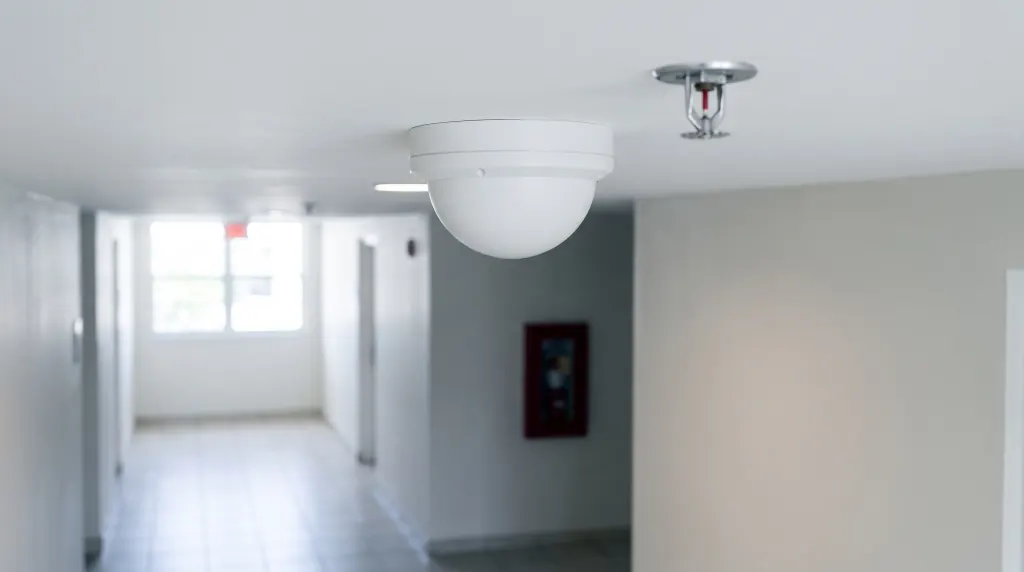
The terms
- Signal booster. The federal rules' word for a device that receives, amplifies and retransmits signals into and out of buildings where they would otherwise be too weak (47 CFR 90.219(a)).
- BDA (bi-directional amplifier). A signal booster that works both ways: downlink from the tower to radios inside, uplink from those radios back to the tower.
- DAS (distributed antenna system). The federal definition is a network of spatially separated antenna nodes connected to a common source through a transport medium, providing wireless service in an area or structure (47 CFR 90.219(a)).
- Public safety DAS. A DAS built for public safety radio, usually fed by a BDA. It is how an ERRCS reaches every floor.
- Cellular DAS. A DAS for phone carriers' commercial service. It does not satisfy ERRCS rules.
In short, most ERRCS installs are a BDA plus a public safety DAS. Larger buildings and campuses may use fiber to carry the signal to remote units; Phoenix, for example, says large buildings, high-rises and campuses may need a fiber networked system (Phoenix Explanatory Policy).
Three systems, one question
Which of these satisfies the fire code?
BDA (signal booster)
- What it is
- An amplifier that works both ways: down from the tower to radios inside, and up from them back out.
- Whose radios
- Fire, police and EMS radio channels.
- Permission
- Express consent of the frequency licensee, kept on record; Class B units registered with the FCC.
- Counts for ERRCS?
- Yes Usually the core of the system.
Public safety DAS
- What it is
- A network of antenna nodes connected to a common source, built for public safety radio and usually fed by a BDA.
- Whose radios
- Fire, police and EMS radio channels.
- Permission
- Same as the BDA that feeds it.
- Counts for ERRCS?
- Yes It is how an ERRCS reaches every floor.
Cellular DAS
- What it is
- An antenna system for phone carriers' commercial service.
- Whose radios
- Tenants' and residents' phones.
- If it interferes
- A non-public-safety amplifier that degrades the ERRCS must be corrected or removed.
- Counts for ERRCS?
- No It does not satisfy ERRCS rules.
Class A and Class B boosters
Federal rules split boosters into two classes (47 CFR 90.219(a)):
| Class | Definition | Registration | Local preference we have read |
|---|---|---|---|
| Class A | Retransmits specific channels; no passband wider than 75 kHz | Not required by 90.219(d)(5) | San Diego and Pierce County require Class A only |
| Class B | Retransmits a wide band; passband wider than 75 kHz | Must be registered in the FCC signal booster database | Pierce County will not approve Class B devices |
Sources: 47 CFR 90.219(a) and (d)(5); SDFD ERRCS guideline; Pierce County ERRCS Handout. Your fire department's technical criteria decide which class you may use.
Sharing equipment with a cellular DAS
| Jurisdiction | Rule |
|---|---|
| Federal (47 CFR 90.219(d)(7)) | Boosters should use the minimum passband needed. Except for DAS installed in buildings, a Class B booster's passband should not cover both commercial and public safety services |
| Los Angeles (LAFD Requirement #105) | Cellular DAS amplifiers may share common passive devices if public safety coverage is not compromised; multi-band antenna design must be shown on as-built drawings |
| Palo Alto (PAFD 510.4.2.2.1) | The ERRCS, from head-end amplifier to antennas, may not be combined with other DAS in the building |
When the cellular DAS causes problems
The model code says that if a non-public-safety amplifier in the building reduces the ERRCS's performance or causes interference, the non-public-safety system must be corrected or removed (IFC 2021 510.6.3). Plan both systems together if you are installing them at the same time.
Find your local rules on the requirements pages, or read the BDA system overview. Confirm with your fire marshal (AHJ).
Next step
Take the board a plan, not just a problem
Ask for up to 3 quotes from vetted installers who serve your area, or start with a one-page brief the board can read before the next meeting. Free for owners, boards and managers. No texts, no cold calls.
Questions people ask
Can my cell phone booster count as an ERRCS?
No. A cellular booster or cellular DAS carries commercial carrier signals. ERRCS rules are about the public safety radio systems your fire department uses, on frequencies licensed to a public safety agency (IFC 2021 510.5.2).
Can one DAS carry both cellular and public safety signals?
It depends on your fire department. Federal rules say that, except for DAS installed in buildings, a Class B booster's passband should not cover both commercial and public safety services (47 CFR 90.219(d)(7)). Los Angeles allows cellular DAS amplifiers to share passive devices if public safety coverage is not compromised; Palo Alto forbids combining its ERRCS with other DAS (LAFD Requirement #105; PAFD 510.4.2.2.1).
Sources
Primary documents we read for this page. Rules change; confirm with your fire marshal (AHJ).
- 47 CFR 90.219, Use of signal boosters, Electronic Code of Federal Regulations
- International Fire Code 2021, Section 510 (text as published by the City of Eaton), City of Eaton, reproducing the ICC International Fire Code
- Requirement, Los Angeles Fire Department
- PAFD Section 510, ERRCS Codes and Addendums (Rev. 06/25/2020), City of Palo Alto Fire Department
- Fire Prevention Section Explanatory Policy Manual 2026, Emergency Responder Radio Coverage, City of Phoenix Fire Department
- San Diego Fire-Rescue ERRCS guideline (9/22/23), City of San Diego
- ERRCS Handout (effective 11/15/2022), Pierce County Fire Prevention Bureau
Related
BDA systems for firefighter radio coverage
What a BDA (bi-directional amplifier) system is, the parts it needs, the FCC and fire code rules it must meet, and how owners find their local requirements.
ERCES, ERRCS, BDA and the other names for firefighter radio coverage
ERCES, ERRCS, ERCC, ERRS, BDA and public safety DAS all describe in-building radio coverage for firefighters. Which code or city uses which name, and why it matters.
What is ERRCS?
ERRCS means in-building radio coverage for firefighters and police. Why fire codes require it, who sets the rules, who pays, and what owners must do.