Owner help
Your building failed a radio coverage test. Here is what to do next.
A failed radio coverage test means too many spots on at least one floor are below the signal level the fire department set. It does not always mean a full new system: the fix can be more indoor antennas, retuning, or a BDA. Get the test report, ask for a design from at least two installers, and file the permit before your deadline. In Florida, an existing building cited after the statewide dates gets at least one year from the notice (F.S. 633.202(18)(g)).
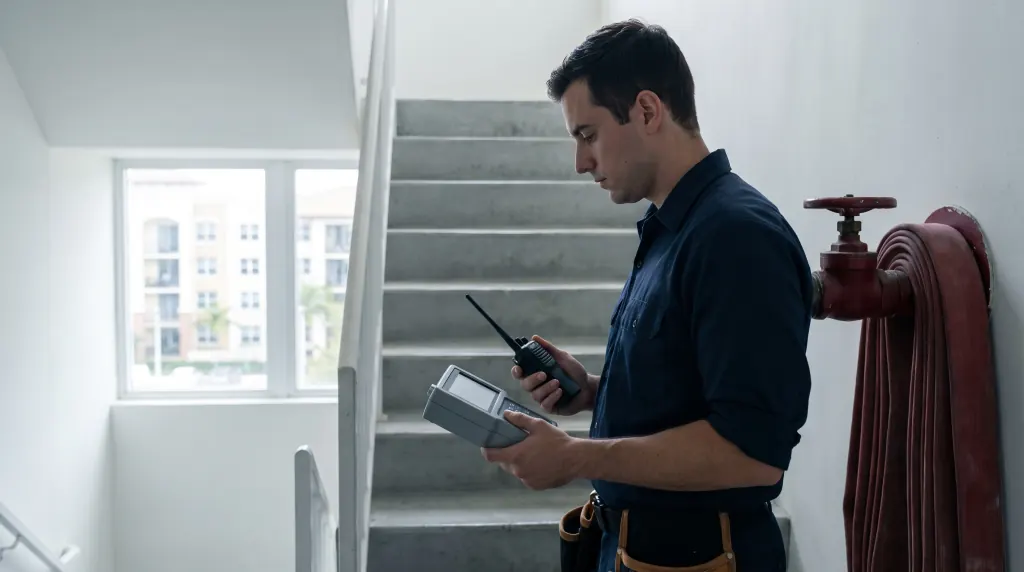
What the result means
A coverage test (often called a grid test) divides each floor into roughly equal squares and measures the fire department's radio signal in each one. Under the 2021 model fire code, a floor passes when 95 percent of its area and 99 percent of its critical areas meet the signal level the fire department set: at least -95 dBm inbound and clear voice, measured as DAQ 3.0 (IFC 2021 510.4.1, 510.4.1.1). NFPA 1225 uses the same 99 percent rule for critical areas such as exit stairs, elevator lobbies and the fire pump room (NFPA 1225 18.8.3).
So "failed" means one of three things, and the report tells you which:
- A floor fell under the general area number. Often the garage, the basement or the core of a large floor plate.
- A critical area fell short. One stairwell or elevator lobby can fail the whole floor.
- The voice check failed even where the signal number looked fine, which points at noise or a system that is oscillating.
Ask the tester for the full report with the floor grids, not just a pass or fail letter. Every installer will need it to design a fix.
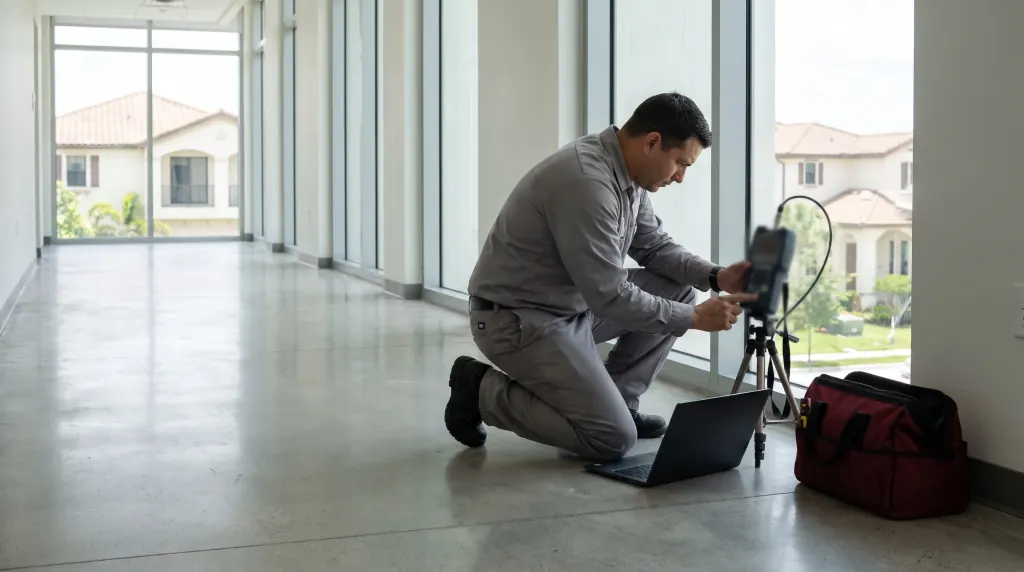
The fixes, from small to large
| Situation | Typical fix | What drives the price |
|---|---|---|
| Building has a system, a few squares failed | Add or move indoor antennas, replace a damaged cable or splitter, retune the amplifier | Floors affected, ceiling access |
| Building has a system, voice check failed | Find the noise or oscillation source, adjust gain and isolation (IFC 2021 510.4.2.4 requires a 20 dB isolation margin and oscillation control) | Diagnostic time, parts |
| No system, failures on a few floors | BDA with antennas only where the grids failed, plus the donor antenna on the roof | Floors and areas covered, cable runs |
| No system, failures on most floors | Full BDA or distributed antenna system with fire alarm monitoring and backup battery | Building height, floor plate, riser space |
Two things are needed for any new system or change to an existing one: written consent from the agency that holds the radio license (47 CFR 90.219(b)(1)(i), and in Florida F.S. 633.202(18)(d)) and a permit from the fire department (IFC 2021 510.3). An installer who skips either one is a red flag.
For the full sequence from survey to sign-off, see the ERRCS project, step by step. For how the annual and acceptance tests run, see how a BDA system is tested.
The clock in Florida
Florida requires existing buildings to meet the minimum signal level the local fire marshal sets, with exemptions for small and low-rise buildings (F.S. 633.202(18)(a), (18)(h)). Existing high-rises had until January 1, 2025.
If the fire marshal requires an existing building to retrofit after those dates, the owner gets at least one year from the notice of code violation (F.S. 633.202(18)(g)). That year goes fast:
- 2 to 4 weeks to collect bids on the same scope.
- A board vote or owner approval, and for condos often a special assessment.
- The radio license holder's consent and the permit review.
- Installation, then a new acceptance test on every floor.
If your test was a routine re-check rather than a fire marshal finding, Florida limits how often the fire marshal can require a coverage assessment: once every 3 years for high-rises and buildings over 12,000 gross square feet, once every 5 years for others, with exceptions after major alterations or a reported radio failure (F.S. 633.202(18)(c)2).
How to get bids you can compare
Send every installer the same packet:
- The full test report with floor grids and the date tested.
- Building height, floors below grade and gross square feet.
- The fire department's own ERRCS criteria (most publish them; your local requirements page links to it where we found one).
- The deadline on your notice, if there is one.
Then ask each one the same four questions: which failed squares their design covers, whether the price includes the license holder's consent and the permit, who runs the acceptance test, and what the annual test and monitoring will cost after. Condo boards can print these as a board brief.
If you want help finding installers, the form below sends your request to up to 3 licensed installers who serve your area. They contact you by email, or by phone only if you choose calls.
Free for owners, boards and managers
Get up to 3 quotes to fix a failed test
Two minutes, no upload. Keep the test report handy: every installer will ask for it.
- Up to 3 licensed installers who serve your area may contact you. Never more than 3.
- By email, or by phone call only if you choose calls below.
- No texts, no robocalls, and we never sell your request to a marketing list.
- Owners never pay us. Installers pay ERRCSCheck for the introduction.
- If no installer covers your area, we tell you within 2 business days and send your local requirements instead.
ERRCSCheck is a private company, not a government agency or fire department.
Request received
Thank you. Up to 3 licensed installers who serve your area will contact you, usually within 2 business days.
Next step
Take the board a plan, not just a problem
Ask for up to 3 quotes from vetted installers who serve your area, or start with a one-page brief the board can read before the next meeting. Free for owners, boards and managers. No texts, no cold calls.
Questions people ask
Does a failed coverage test mean we need a whole new BDA system?
Not always. If the building already has a system, a fail can come from a few dead spots, a failed antenna or cable, or settings that drifted. If the building has no system, the fix is usually a BDA with indoor antennas, but how much of the building needs antennas depends on which floors and areas failed. Ask each installer to tie the design to the failed squares on the report.
How many grid squares can fail?
Under the 2021 model fire code, coverage is acceptable when 95 percent of each floor and 99 percent of critical areas meet the signal level (IFC 2021 510.4.1). Critical areas include fire command centers, fire pump rooms, exit stairs, exit passageways, elevator lobbies, standpipe cabinets and sprinkler valve locations (NFPA 1225 18.8.3). Your fire department can set stricter numbers, so read its own criteria.
How long do we have to fix it in Florida?
If the fire marshal requires an existing building to retrofit after the statewide 2024 and 2025 dates, the owner gets at least one year from the notice of code violation to finish (F.S. 633.202(18)(g)). Use the date on your notice, and file the permit early: the radio license holder's written consent and the permit both take time.
Can the company that ran the test also fix it?
Yes, but you are not required to hire them. Ask for the full report with the floor grids, then get at least two more designs on the same scope so the board or owner can compare like for like.
Sources
Primary documents we read for this page. Rules change; confirm with your fire marshal (AHJ).
- International Fire Code 2021, Section 510 (text as published by the City of Eaton), City of Eaton, reproducing the ICC International Fire Code
- NFPA 1225, Standard for Emergency Services Communications, 2022 Edition: Chapter 18 and section 20.3.10, Georgia Office of Commissioner of Insurance and Safety Fire, reproducing NFPA 1225
- Florida Statutes 2026, section 633.202, subsection (18), The Florida Senate
- 47 CFR 90.219, Use of signal boosters, Electronic Code of Federal Regulations
Related
Something happened with your building's radio coverage. Start here.
Plain next steps for owners, condo boards and managers: failed coverage test, fire marshal order, expired permit, CO on hold or a board that needs quotes.
The ERRCS project, step by step
The five steps of an ERRCS project, from checking the rule to the annual test: who does each one, what it produces, how long it takes and what goes wrong.
How a BDA system is tested
What happens in a BDA acceptance test and an annual BDA test under the fire code: grid testing, gain checks, battery load tests, oscillation checks and reports.
What will the ERRCS work cost each owner?
Split an ERRCS or BDA project cost across the owners, with optional reserve money and published fire department fees. Sourced figures only, estimate only.