Owner help
The fire marshal says your building must install ERRCS. Here is your plan.
When the fire marshal orders an ERRCS or BDA system, first confirm the building is not exempt and that the signal outside is strong enough to carry in (F.S. 633.202(18)(h) and (18)(e)). Then get a floor-by-floor signal test, bids on the same scope, the radio license holder's written consent and a permit (IFC 2021 510.3). In Florida, an existing building ordered to retrofit after the statewide dates gets at least one year from the notice of code violation (F.S. 633.202(18)(g)). Reply to the fire marshal in writing with your plan and dates.
Read the order line by line
A general notice asks you to look into radio coverage. An order to install a system is more specific: the fire marshal has decided your building needs a two-way radio enhancement system, usually called a BDA system or ERRCS. In Florida, the fire marshal may require one when a building cannot support the minimum signal level (F.S. 633.202(18)(c)1).
Before you call an installer, mark these on the order:
- What it requires: a test, a design, a permit application, or a working system.
- The code section: in Florida usually F.S. 633.202(18), elsewhere often IFC Section 510.
- The date: when the work must be done, or when the fire marshal expects to hear from you.
- The evidence: whether a test was run, by whom, and on which floors.
If you only have a short letter with no code section or date, the general walk-throughs at Got a notice? and what to do after a citation cover that first triage. This page is for owners who already know a system is being required.
Step 1: Confirm the rule applies to your building
Florida law exempts some buildings outright (F.S. 633.202(18)(h)), and it requires no system or assessment where the fire marshal finds the public safety signal inadequate at the outside of the building (F.S. 633.202(18)(e)).
| Check | What to look for | Citation |
|---|---|---|
| Homes and townhouses | One- and two-family dwellings and townhouses are exempt | F.S. 633.202(18)(h)1 |
| Small buildings | Under 12,000 total gross square feet and no underground areas | F.S. 633.202(18)(h)2 |
| Low-rise apartments and lodging | Under three stories, with direct access from each unit to an exterior exit | F.S. 633.202(18)(h)3 |
| Some wood-frame apartments | 75 feet or less, wood frame, fewer than 150 units, every unit opens to the outside or a corridor leading straight to an exit | F.S. 633.202(18)(h)4 |
| Weak signal outside | The public safety signal is inadequate at the exterior | F.S. 633.202(18)(e) |
The building checker applies these and cites each one. If you think one fits, put it in writing to the fire marshal before you spend money on design.
Step 2: Measure before you buy
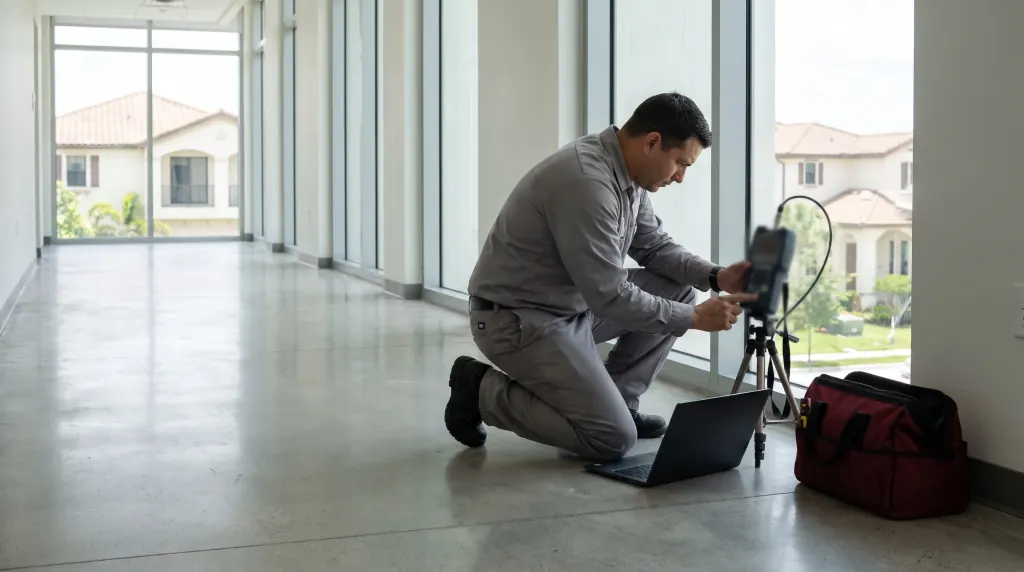
A signal test (also called a survey or grid test) shows which floors and areas fall short. The model code sets the bar at 95 percent of all areas and 99 percent of critical areas on each floor (IFC 2021 510.4.1). Ask the fire department for its technical criteria document first, which lists the frequencies and design details (IFC 2021 510.4.2.2), so the test is run on the right channels.
A good test can shrink the job. A building that fails only in the garage and stairwells may need far fewer antennas than one that fails on every floor. If you already have a failed report, see failed a radio coverage test.
Step 3: Know your clock
Existing Florida high-rises had to comply by January 1, 2025 (F.S. 633.202(18)(a)). If the fire marshal requires an existing building to retrofit after the statewide dates, the owner gets at least one year to finish, starting when the notice of code violation is issued (F.S. 633.202(18)(g)). The date on your order controls if it is later.
Work backward from that date. Leave room for bids, an owner or board vote, the license holder's consent, permit review, installation and the acceptance test on every floor (IFC 2021 510.5.4). The ERRCS project, step by step shows who does each part.
Step 4: Get consent and the permit
- License holder consent. The agency that holds the radio license (usually the county, city or regional radio system) must give express consent before a booster operates, kept in a recordable format (47 CFR 90.219(b)(1)(i)). Florida requires the same for any new system or change to an existing one (F.S. 633.202(18)(d)).
- Permit. Installing or modifying a system needs a construction permit (IFC 2021 510.3).
- Monitoring. The system reports trouble to the fire alarm panel (IFC 2021 510.4.2.5), so your fire alarm contractor is part of the job.
Ask every bidder whether consent, the permit and the fire alarm tie-in are in the price.
Step 5: Build a budget
There is no public price list. One news report on Fort Lauderdale high-rises said systems can cost $250,000 or more (Sun Sentinel via Firehouse, November 2025). Your building may cost much less or more; only a test and written bids will tell you. Add the yearly test the code requires after installation (IFC 2021 510.6.1). For a condo, split the bid with the cost per owner calculator, and see the condo board quote checklist.
Step 6: Reply to the fire marshal in writing
A short written reply shows good faith and creates a record. Send it to the contact on the order, by email or letter, and keep a copy. Include:
- The building address and the order or case number.
- One contact person for the building, with phone and email.
- Any exemption you are claiming, with the citation, or a statement that you accept the order.
- Your plan: test date, bid date, expected permit application date and target completion.
- A request for the fire department's technical criteria document if you do not have it.
- A request to confirm in writing what will close the order (often the acceptance test report and permit sign-off).
Update the fire marshal when a date slips, before the deadline, not after.
Get comparable quotes
When you are ready for prices, the form below sends your request to up to 3 licensed installers who serve your area. They reach you by email, or by phone only if you choose calls.
Free for owners, boards and managers
Get up to 3 quotes for the system the fire marshal wants
Two minutes. We send your request to installers who work in your county and know your fire marshal.
- Up to 3 licensed installers who serve your area may contact you. Never more than 3.
- By email, or by phone call only if you choose calls below.
- No texts, no robocalls, and we never sell your request to a marketing list.
- Owners never pay us. Installers pay ERRCSCheck for the introduction.
- If no installer covers your area, we tell you within 2 business days and send your local requirements instead.
ERRCSCheck is a private company, not a government agency or fire department.
Request received
Thank you. Up to 3 licensed installers who serve your area will contact you, usually within 2 business days.
Next step
Take the board a plan, not just a problem
Ask for up to 3 quotes from vetted installers who serve your area, or start with a one-page brief the board can read before the next meeting. Free for owners, boards and managers. No texts, no cold calls.
Questions people ask
Can the fire marshal order a system without testing the building?
The fire code judges coverage by measurement inside the building against the signal outside (IFC 2021 510.1, 510.4.1). In Florida, the fire marshal may require a system when the building cannot support the required signal level (F.S. 633.202(18)(c)1). If your order does not say what was measured, ask in writing for the test results behind it.
Our building is small. Could it be exempt?
Possibly. Florida exempts one- and two-family homes and townhouses, buildings under 12,000 gross square feet with no underground areas, some low-rise apartments and some wood-frame apartment buildings (F.S. 633.202(18)(h)). Run the building checker and, if you think you qualify, say so in your written reply with the citation.
Is ERRCSCheck the fire department?
No. ERRCSCheck is a private company, not a government agency. Only your fire marshal can change or close the order.
Do we have to use the company the fire marshal mentioned?
Nothing in the fire code requires a particular company. The designer and lead installer need an FCC general radio operator license and in-building system training at minimum (IFC 2021 510.5.3), and your city may add more. Compare written bids on the same scope.
Sources
Primary documents we read for this page. Rules change; confirm with your fire marshal (AHJ).
- Florida Statutes 2026, section 633.202, subsection (18), The Florida Senate
- International Fire Code 2021, Section 510 (text as published by the City of Eaton), City of Eaton, reproducing the ICC International Fire Code
- 47 CFR 90.219, Use of signal boosters, Electronic Code of Federal Regulations
- Fort Lauderdale cites 69 high-rises with weak radio signals (South Florida Sun Sentinel, republished by Firehouse, November 7, 2025), Firehouse
Related
Something happened with your building's radio coverage. Start here.
Plain next steps for owners, condo boards and managers: failed coverage test, fire marshal order, expired permit, CO on hold or a board that needs quotes.
Your building failed a radio coverage test. Here is what to do next.
Failed an ERRCS signal or grid test? What the result means, the fix options from antennas to a full BDA, how long Florida gives you, and how to get bids.
Your condo board needs ERRCS bids now. Use this checklist.
A board checklist for collecting ERRCS or BDA bids: what to decide, how many bids, what every quote must include, cost per owner and the Florida dates.
You got a fire marshal notice about radio coverage. Now what?
A step-by-step plan for owners and managers after an ERRCS or BDA notice of violation: read the deadline, test, hire qualified help, get consent and permits.