Florida · county · ERRCS / BDA requirements
ERRCS and BDA requirements in Palm Beach County, Florida
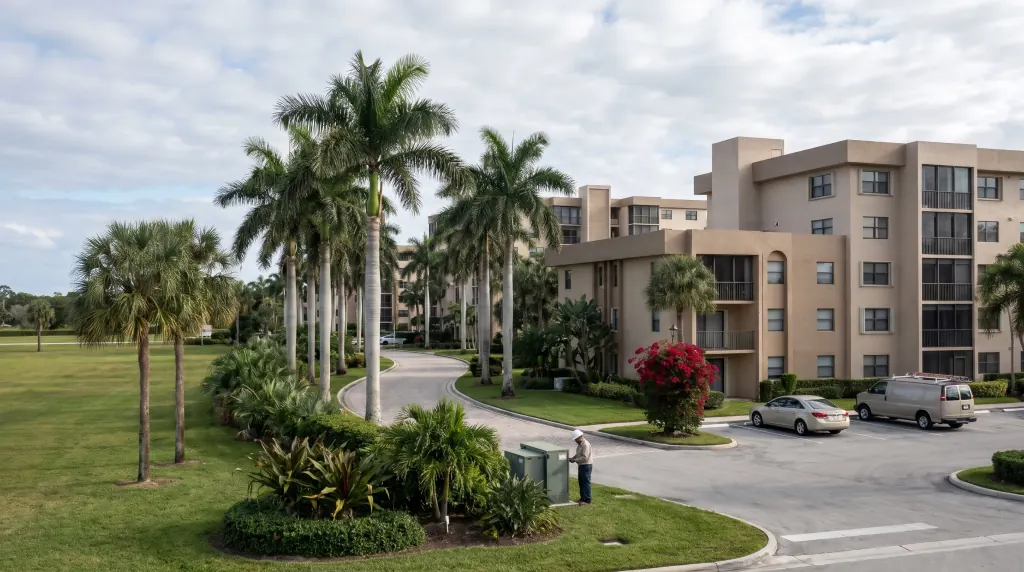
Palm Beach County Fire Rescue requires a minimum signal of -102 dBm in buildings that meet the criteria of F.S. 633.202(18)(a). Where that cannot be reached, a 700-800 MHz BDA with a 24-hour battery or UPS must be installed. These rules apply in unincorporated areas and in cities served by PBCFR that adopted the county amendments.
Guidance, not engineering advice. Rules on this page come from the documents listed under Sources. Confirm with Palm Beach County Fire Rescue (PBCFR), Community Risk Reduction Division before you design, permit or test a system.
Who must comply
State rules apply here too. See Florida statewide rules.
| Rule | Effect | Citation | Source |
|---|---|---|---|
| A preliminary RF scan is required for PBCFR review once the structure is completely closed in (roof, doors and windows installed). | Note | PBCFR BDA requirements | Palm Beach County Fire Rescue, Community Risk Reduction Division |
| Even passing RF scans must be submitted to PBCFR Plan Review. Scans for existing residential buildings include units and common areas. | Note | PBCFR BDA requirements | Palm Beach County Fire Rescue, Community Risk Reduction Division |
| Trigger | Published value |
|---|---|
| Minimum building size | Not published; confirm with the fire marshal |
| Minimum stories | Not published; confirm with the fire marshal |
| Height trigger | Not published; confirm with the fire marshal |
| Below-grade areas | Not published; confirm with the fire marshal |
| Building types named | Not published; confirm with the fire marshal |
| Existing buildings must retrofit | Yes |
| Compliance deadline | Not published; confirm with the fire marshal |
Cities with their own fire departments, such as West Palm Beach and Boca Raton, are separate AHJs. State law bars local fire marshals from enforcing requirements stricter than the Florida Fire Prevention Code and the statute for requiring, designing or installing a system (F.S. 633.202(18)(i)); if a local item seems stricter, ask PBCFR how it applies to your building.
Signal and coverage
| Requirement | Value |
|---|---|
| Minimum downlink signal | -102 dBm |
| Minimum uplink signal | Not published; confirm with the fire marshal |
| Delivered audio quality (DAQ) | Not published; confirm with the fire marshal |
| Coverage, general areas | Not published; confirm with the fire marshal |
| Coverage, critical areas | Not published; confirm with the fire marshal |
| Critical areas named | Not published; confirm with the fire marshal |
| Public safety radio bands | 700-800 MHz (PBC Radio Division confirms the exact frequencies) |
The local amendment text lists 806-821/851-866 MHz; the newer BDA requirements sheet says 700-800 MHz. RF scans must include SNR, FBER and threshold settings and be graded. Coverage percentages are not stated in these documents.
How coverage is tested
One floor, 20 squares, a radio check in each
- 20 test areas per floorEach floor is divided into a grid of 20 roughly equal areas.IFC 2021 510.5.4
- One test spot per areaA spot near the center stands for the whole area. No extra spots after it is chosen.
- One failed area is allowedMore than one failed area fails the floor. With exactly two, the floor may be re-divided into 40 areas, and up to two non-adjacent failures are allowed.IFC 2021 510.5.4
- Critical areas count moreTypical model-code targets: 95 percent of all areas and 99 percent of critical areas such as stairs and elevator lobbies. Your fire marshal sets the numbers that apply to you.IFC 2021 510.4.1
Illustration: 19 of 20 areas pass, so this floor passes. Some fire departments use other numbers; Miami-Dade, for example, stops an acceptance test below 90 percent of general areas.
Testing
| Test | What the source says | Source |
|---|---|---|
| Acceptance test | All new BDA systems must be commissioned by the PBC Radio Division before fire department inspections. | PBCFR BDA requirements |
| Annual test | Not published in the PBCFR BDA documents; a service contract is required instead. Confirm annual testing with the fire marshal. | None found |
| Five-year test | An RF scan is required every 5 years after initial installation to confirm the system still works. | Local Amendments 11.10.7 |
| Coverage assessment interval | Set by state law: the fire marshal may require an interior coverage assessment no more than once every 3 years for an existing high-rise or an existing building over 12,000 total gross square feet, and once every 5 years for other existing buildings, with exceptions for major alterations, reported radio failures and imminent threats. | F.S. 633.202(18)(c)2 |
Maintenance and monitoring
- A service contract is required on all new and existing systems (11.10.8).
- Battery or UPS run time of 24 hours (11.10.4).
- A BDA, area of refuge and fire alarm annunciator within 25 feet of the entry door from outside, with no intervening doors (11.10.5).
- Circuits and wiring, including antennas, meet survivability requirements, except the donor antenna (11.10.6).
- A sequence of operations for trouble conditions is kept at the BDA control panel (11.10.9).
Permit and inspection process
- Once the building is closed in, have a preliminary RF scan done and email it to [email protected] for review by PBCFR and the PBC Radio Division. PBCFR BDA requirements
- If the scan fails, submit BDA plans to PBCFR Plan Review meeting NFPA 72, NFPA 1221 and Chapter 11 of the county amendments. PBCFR BDA requirements
- Have the PBC Radio Division commission the system, then schedule fire department inspections. PBCFR BDA requirements
After a notice
Six steps from the letter to a closed violation
- Read the noticeWrite down the code section, the deadline, the contact and what it asks for.
- Check the ruleRun the checker for your building and look for a published exemption.
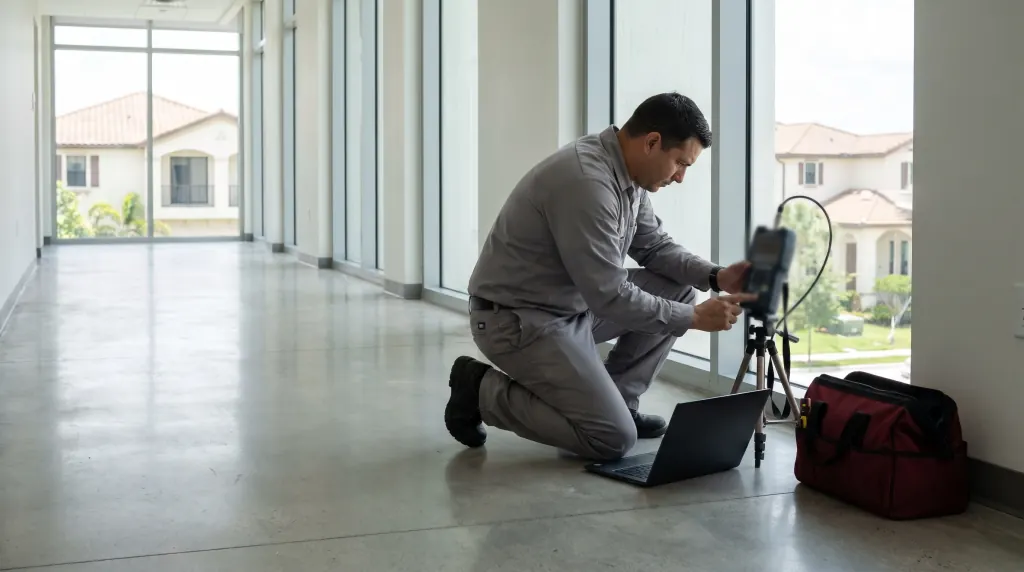
- Get a signal testYou cannot size a fix without measuring floor by floor.IFC 2021 510.4.2.2
- Hire qualified peopleFCC general radio operator license and in-building training, at minimum.IFC 2021 510.5.3
- Consent, permit, install, testRadio licensee's consent, a permit, then the acceptance test.47 CFR 90.219(b)(1)(i); IFC 2021 510.3, 510.5.4
- Keep it compliantAn annual test and a report to the fire department, records kept on site.IFC 2021 510.6.1
In Florida, a required retrofit after the statutory dates gets at least 1 year from the notice of code violation (F.S. 633.202(18)(g)). Elsewhere, the date on your notice controls.
Your notice
How long do we have?
Every date here comes from the statute or rule cited under it.
In Florida, after the fire marshal issues a notice of code violation, the owner gets at least 1 year to complete a required retrofit. The date written on your notice controls; it may give you more. F.S. 633.202(18)(g)
Codes and standards referenced
| Code or standard | Edition | Source |
|---|---|---|
| Florida Fire Prevention Code (NFPA 1 and NFPA 101, Florida editions), in force statewide | 8th edition (NFPA 1, Florida 2021 edition), effective December 31, 2023 | rule |
| Palm Beach County Local Amendments to the Florida Fire Prevention Code, Chapter 11, section 11.10 | Effective December 31, 2023 | pbcla |
| NFPA 72 and NFPA 1221 (current editions named in the BDA requirements) | Not published; confirm with the fire marshal | pbcbda |
Next step
Take the board a plan, not just a problem
Ask for up to 3 quotes from vetted installers who serve your area, or start with a one-page brief the board can read before the next meeting. Free for owners, boards and managers. No texts, no cold calls.
Questions people ask
What signal level does Palm Beach County Fire Rescue require?
A minimum of -102 dBm in the 700-800 MHz public safety band. Where that cannot be met, a BDA with a 24-hour battery or UPS must be installed.
Do we have to re-test after the system is installed?
Yes. The county amendments require an RF scan every 5 years after initial installation, and a service contract on every system.
Our scan passed. Do we still send it in?
Yes. PBCFR says all passing RF scans must still be submitted to Plan Review.
Sources
Primary documents we read for this page. Rules change; confirm with your fire marshal (AHJ).
- Florida Statutes 2026, section 633.202, subsection (18), The Florida Senate
- Florida Fire Prevention Code, 8th edition: Florida amendments to NFPA 1 (2021 edition), sections 11.10.2 and 11.10.2.1, Florida Division of State Fire Marshal
- Rule 69A-60.003, F.A.C.: NFPA 1, the Fire Code, Florida 2021 edition, adopted (effective 12/31/2023), Florida Department of State, Florida Administrative Code
- Bi-Directional Amplifier (BDA) / Distributed Antenna Systems (DAS): Plan Submission and Installation Requirements, Palm Beach County Fire Rescue, Community Risk Reduction Division
- Palm Beach County Local Amendments to the Florida Fire Prevention Code (effective December 31, 2023), section 11.10, Palm Beach County Fire Rescue
- Plan Review, Palm Beach County Fire Rescue, Community Risk Reduction Division